

The Cultural Sustainability Audit
Tourism and local culture are deeply interdependent: culture shapes the destination, while tourism can strengthen or place pressure on its long-term vitality. Yet few tourism organizations have a structured way to understand and manage that relationship.
The Cultural Sustainability Audit fills that gap. Grounded in cultural sustainability principles and internationally recognized best practices in cultural tourism, it helps organizations assess current practices, recognize strengths, and identify where their approach can be strengthened.
Designed for both individual tourism organizations and destinations, the audit provides a clear starting point for putting cultural sustainability into practice.
A Practical Tool For Assessing Cultural Sustainability Practices
Inform Better Tourism Decisions
Use your insights to inform decisions about:
Destination planning and development – Ensure tourism growth supports the cultural identities and priorities of local communities.
Product and experience development – Create visitor experiences that are culturally respectful, accurate representations, and mutually beneficial.
Community engagement – Strengthen relationships with cultural practitioners, community organizations, and residents.
Marketing and storytelling – Represent local cultures accurately, respectfully, and inclusively.
Partnerships and funding priorities – Identify where collaboration and investment can have the greatest cultural impact.
Policies and internal practices – Align organizational decisions with recognized best practices in cultural sustainability.
Monitoring progress over time – Establish a baseline, measure improvement, and demonstrate your commitment to cultural sustainability.

Choose The Right Offering

Destination Organization
For destination management organizations, regional tourism organizations, destination partnerships, and tourism authorities.
Evaluate how cultural sustainability is reflected across destination planning, partnerships, policies, and management.
Includes:
Destination Cultural Sustainability Self-Audit
Review and interpretation of findings
Customized Cultural Sustainability Insights Report
Strategic recommendations
Strategy session
The Destination Partner Badge
Ideal for destinations seeking a baseline to inform planning, investment, and long-term destination management.

Destination-Wide Program
For destinations seeking a broader understanding across their tourism ecosystem.
Combine the destination's internal perspective with participation from tourism businesses throughout the destination.
Includes:
Destination Cultural Sustainability Self-Audit
Sponsored operator participation
Individual Results Summaries and Reflection Guides for participating organizations
Aggregated operator findings
Destination-wide benchmarking
Customized Destination Cultural Sustainability Insights Report
Strategy session with destination leadership
The Cultural Sustainability Destination Partner Badge
A comprehensive understanding of how tourism supports cultural sustainability across the destination.

Individual tourism Organization
For tour operators, hotels, attractions, museums, cultural organizations, and tourism businesses.
Understand how your own operations support cultural sustainability.
Includes:
Online Cultural Sustainability Self-Audit
Overall score and maturity level
Domain-by-domain results
Automated Results Summary
Reflection Guide to help interpret your results and identify next steps
The Participating Organization Badge
A practical starting point for organizations looking to strengthen their cultural sustainability practices.
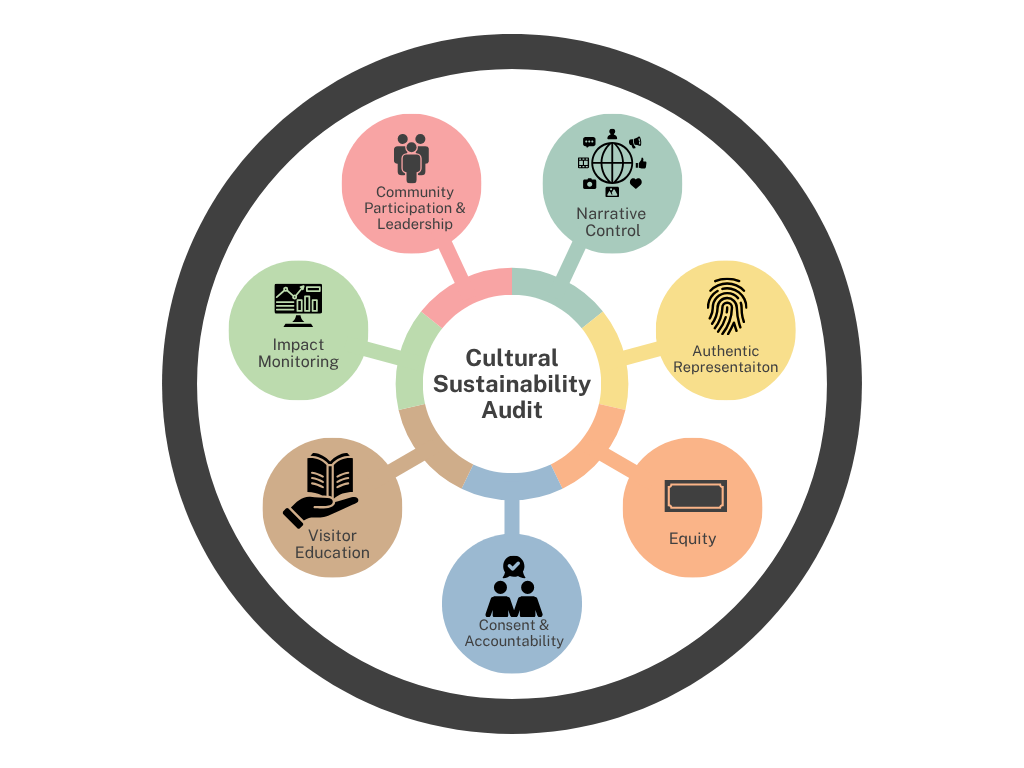
Audit Features
Designed from Principles of Cultural Sustainability and Best Practices in Cultural Tourism
The Cultural Sustainability in Tourism Self-Audit consists of structured questions organized across essential domains of cultural sustainability in tourism:
Community Participation & Leadership
Cultural Representation & Narrative Integrity
Cultural Experience Design
Local Benefit & the Cultural Economy
Consent, Rights, & Accountablity
Planning and Governance
Visitor Engagment
Impact Monitoring
Operationalizing International Best Practices
The Cultural Sustainability Audit is informed by leading international standards and guidance, with questions mapped against relevant criteria and principles, including:
GSTC Destination Standard v2.0 (2019)
UNESCO Convention for the Safeguarding of the Intangible Cultural Heritage (2003) and Operational Directives (2008, amended 2024)
ICOMOS International Cultural Heritage Tourism Charter (2022)
UN Tourism: Tourism and Intangible Cultural Heritage (2012)
Rather than measuring compliance, the framework helps organizations turn best practices in cultural tourism into action.
What Our Partners Are Saying

Founding Partner Opportunity
A limited number of destinations and tourism organizations are invited to participate during the initial implementation phase.
Founding Participants receive:
Preferred introductory pricing
Early access to the framework
Opportunity to help shape future development
Recognition as an early participant (optional)
Additional implementation support, depending on the engagement.

Ready to Put Cultural Sustainability into Practice?
Whether assessing a single tourism organization or an entire destination, the Cultural Sustainability Audit provides a practical framework for making more informed decisions that help the cultures that shape communities remain living and meaningful parts of their future.